5 Revenue Optimization Strategies for Water Parks and FECs

Why Revenue Optimization Matters More Than Attendance
Most park operators obsess over attendance numbers. But the parks that are actually thriving in 2026 focus on something different: revenue per guest. A park with 50,000 annual visitors generating $35 per head outperforms one with 80,000 visitors at $20 per head — and with far less operational stress.
Here are five revenue optimization strategies that the most successful water parks, FECs, and attraction parks are using right now.
1. Dynamic Pricing: Stop Leaving Money on the Table
If you charge the same price for a Saturday afternoon slot as a Tuesday morning slot, you're leaving significant revenue on the table.
Dynamic pricing adjusts your ticket prices automatically based on demand, time of day, day of week, and capacity utilization. It's not about charging more — it's about charging the right amount at the right time.
How it works in practice:
- High-demand periods (Saturday afternoons, school holidays, rainy days for indoor parks): Prices increase by 20-40% as capacity fills up
- Low-demand periods (weekday mornings, off-season): Prices decrease to attract guests who are price-sensitive but time-flexible
- Last-minute availability: Slight discount on remaining slots to maximize capacity utilization
The results are consistent: Parks that implement true dynamic pricing (not just seasonal pricing) typically see 15-25% revenue increases without any change in total attendance.
What you need: A booking system that supports algorithmic pricing rules — not just the ability to manually set different prices for different days. You want the system to adjust prices automatically based on real-time capacity data.
2. Strategic Upselling at the Point of Sale
The moment a guest books online is your highest-conversion opportunity for upsells. But most parks waste it with clunky add-on menus that feel like an aftermarket car accessory page.
Effective upselling looks like this:
- During booking: "Add grip socks for $3" (trampoline parks), "Include a photo package for $8" (aqua parks), "Upgrade to unlimited time for $5 more"
- At check-in: "Would you like to add 30 minutes to your session?" via the POS
- Post-visit: "Had a great time? Book your next visit at 10% off" via automated email
- One-tap add-ons — Don't make guests go through a separate flow. The upsell should be a single checkbox during checkout.
- Smart defaults — For birthday parties, pre-select the party package that includes food and party room. Let them remove it, not add it.
- Price anchoring — Show the premium option first. "$45 for VIP" makes "$25 for Standard" feel like a deal.
What This Actually Produced at Our Own Park (Added August 2026)
We have since run this for a full season at Charleston Aqua Park and can replace the estimate above with measured numbers. Across 2,175 online bookings between 17 June and 7 August 2026:
- 31.1% of bookings added a second activity at the upgrade price, and the rate held between 28.7% and 33.5% in every complete week
- $12.04 more per booking on average, spread across every booking including the two thirds that decline
- The average basket went from $62.20 without an upgrade to $109.68 with one
The upsell is worth most on your weakest attraction. 83.5% of all our Ropes Course tickets are now sold as an upgrade rather than as a main booking, against 14.2% for the Aqua Park. The activity with poor standalone demand and spare midday capacity is exactly the one to put behind the offer, because you are filling sessions you already pay staff to run.
It sells to a group, not a person. A guest booking alone took the upgrade 21.5% of the time, a party of four 35.9%, a party of seven 52.5%. Which means revenue per upgrade climbs with party size: ours went from $34.43 in June to $43.79 in August with no price change at all.
Discounting the second activity does cannibalize full-price sales, and it is still clearly worth it. We ran half the season without the upgrade flow, which gave us a direct before and after. Bookings taking both activities went from 5.4% to 31.1%, while full-price purchases of the second activity fell from 37 bookings to 3. Second-activity revenue per booking went from $2.69 to $12.06.
Full write-up: we don't bundle, we upsell.
3. Membership and Pass Programs
One-time visitors are expensive to acquire. Repeat visitors are where you build a sustainable business. Membership programs transform occasional guests into regulars with predictable monthly revenue.
Three tiers that work:
- Punch cards / Multi-visit passes — Buy 10 visits, get 2 free. Simple, low commitment. Great for introducing the concept of pre-paying.
- Monthly memberships — Unlimited visits for a flat monthly fee. Works best for parks with high fixed costs and available weekday capacity. The math: if a single visit is $25 and a membership is $49/month, a member who visits 3+ times per month feels they're getting value — while you're getting predictable revenue.
- Annual VIP memberships — Premium tier with perks: skip-the-line access, guest discounts, merchandise discounts, exclusive events. Price at 8-10x a single visit.
- Predictable monthly revenue (cash flow smoothing)
- Higher lifetime value per customer (3-5x vs. one-time visitors)
- Members bring non-member friends (organic acquisition)
- Reduced marketing spend (you're not re-acquiring the same customer)
4. Group Booking Optimization
Birthday parties and corporate events typically represent 30-50% of revenue for FECs and activity parks. Yet most parks handle group bookings like an afterthought — buried contact forms, manual quoting, and phone tag.
How to optimize group revenue:
- Self-service booking — Let parents book a birthday party package online with immediate confirmation. No phone calls, no email back-and-forth. Every friction point costs you bookings.
- Package tiers — Offer 3 packages: Basic ($199), Premium ($299), Ultimate ($399). Most will choose the middle tier (price anchoring), but having a premium option increases average party revenue by 15-20%.
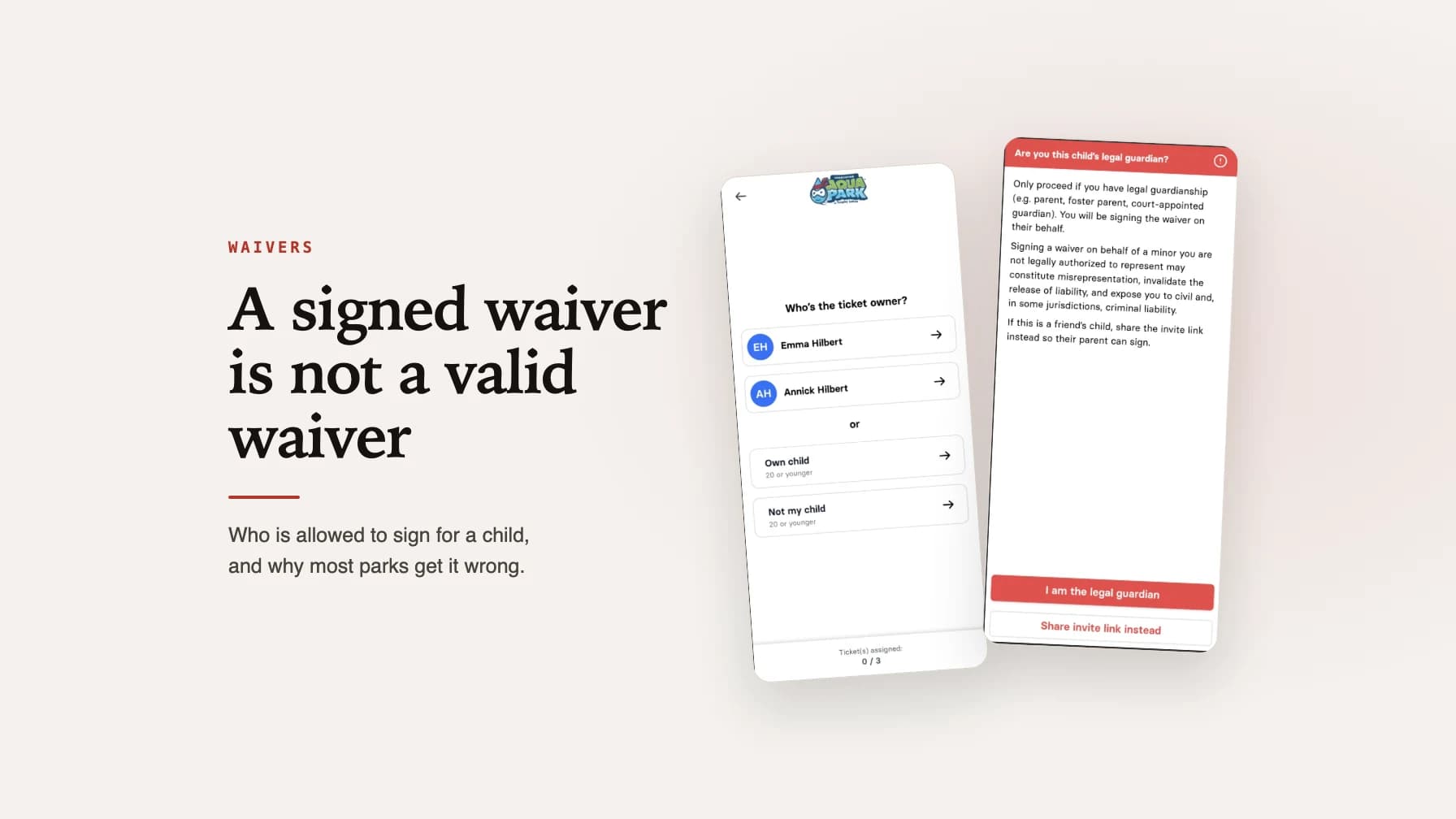
- Shareable invite links — After the organizer books, give them a link to share with guests. Each guest claims their spot and signs their waiver through the link. This eliminates the check-in chaos on party day.
- Minimum guarantees with upside — Charge for a minimum of 10 guests, but make it easy to add more at a per-head rate. You're guaranteed base revenue with upside potential.
- Weekday party incentives — Offer a 20% discount for parties booked Monday-Thursday. This fills dead capacity and doesn't cannibalize premium weekend slots.
5. Seasonal Passes and Event-Based Revenue
Beyond regular operations, seasonal programming can significantly boost revenue during traditionally slow periods.
Seasonal pass strategies:
- Summer passes (for indoor parks) — "Beat the heat" unlimited visits during June-August. Indoor parks are counter-seasonal to outdoor activities.
- Holiday event packages — Halloween events, Christmas experiences, spring break camps. Time-limited events create urgency and justify premium pricing.
- Early bird season passes — Sell next season's passes at a discount during the current season's end. This generates cash flow during your slowest period and locks in future attendance.
- Glow nights — Evening sessions with UV lighting, music, and a premium ticket price (20-30% higher than regular sessions)
- Exclusive hire — Rent the entire venue for corporate team building at 3-5x normal session revenue
- Toddler mornings — Lower-capacity sessions for under-5s at reduced rates. This fills morning slots that would otherwise be empty.
- Fitness programs — Trampoline fitness classes, aqua fitness. These attract a completely different demographic with higher willingness to pay for recurring sessions.
Putting It All Together
The parks generating the highest revenue per guest aren't doing just one of these things — they're doing all five, supported by technology that makes it seamless.
The common thread: modern booking systems enable all of these strategies. Dynamic pricing requires real-time capacity data. Upselling requires a smooth checkout flow. Memberships require automated recurring billing. Group bookings require shareable links and per-guest waivers. Seasonal passes require flexible pass management.
If your current system can't support these strategies, it's not just a technology limitation — it's a revenue limitation.
Start with one strategy, measure the impact, then layer on the next. Most parks see the biggest immediate gains from dynamic pricing (it requires no behavior change from guests) and group booking optimization (it improves the experience while increasing revenue).
The goal isn't to squeeze every dollar from every guest. It's to deliver more value and capture a fair share of it. When guests feel they got a great experience at a fair price, they come back — and that's the ultimate revenue optimization strategy.
Updated 8 August 2026: replaced the estimated upselling figures with measured results from our own 2026 season, including the attach rate, the basket lift, the party-size effect and the before-and-after on cannibalization. Originally published 11 March 2026.

Chris Hilbert
Founder, wakesys
Park operator and software founder. Running Charleston Aqua Park and building wakesys to help activity centers succeed.