We don't bundle, we upsell: what an ice cream shop knows about park revenue
If you run a family entertainment center and you want the single fastest way to lift revenue per guest, it is not a discount and it is not a bundle. It is an in the moment upsell. At the point of booking you offer a second activity or an add-on at a price that makes it an easy yes. At our own park it adds $12.30 to the average online booking, automatically, on every one. That figure now rests on 2,946 online bookings across the whole 2026 season, from the day the upgrade went live in June to the last weekends of September, not on a launch week.
Here is the number that surprised us. Our Ropes Course is the attraction nobody drives across town for. Over the season it sold 963 tickets to people who came looking for it, and 4,596 to people who were already booking something else and got asked. Five out of every six of its tickets exist only because of one question in the booking flow. We have offered that upgrade for years on instinct, and this is the first season we could measure what the instinct was worth. It is a great deal more than we would have guessed. Here is exactly how the mechanic works, and why it beats the discount most operators reach for first.
Start with an ice cream shop, because it explains the whole idea in one picture. You want chocolate, which the IDFA National Ice Cream Trends Survey 2026 confirms is America's favorite flavor, and that is exactly what you came for. A single scoop is $3.50. But there is a sign at the counter. Chocolate with vanilla for $5, or chocolate with pistachio for $5. You do not care. You did not come for a combo, you came for your chocolate, and at worst you are now standing there deliberating instead of simply ordering.
Now the other version. You order your chocolate for $3.50, and the person behind the counter asks whether you would like to add a scoop of vanilla for just $1.50 more. This works because you are already in the middle of ordering, because the decision is small, and because it lands at the right moment. You end up paying the same $5 the bundle would have cost. The only difference is that this time you say yes.
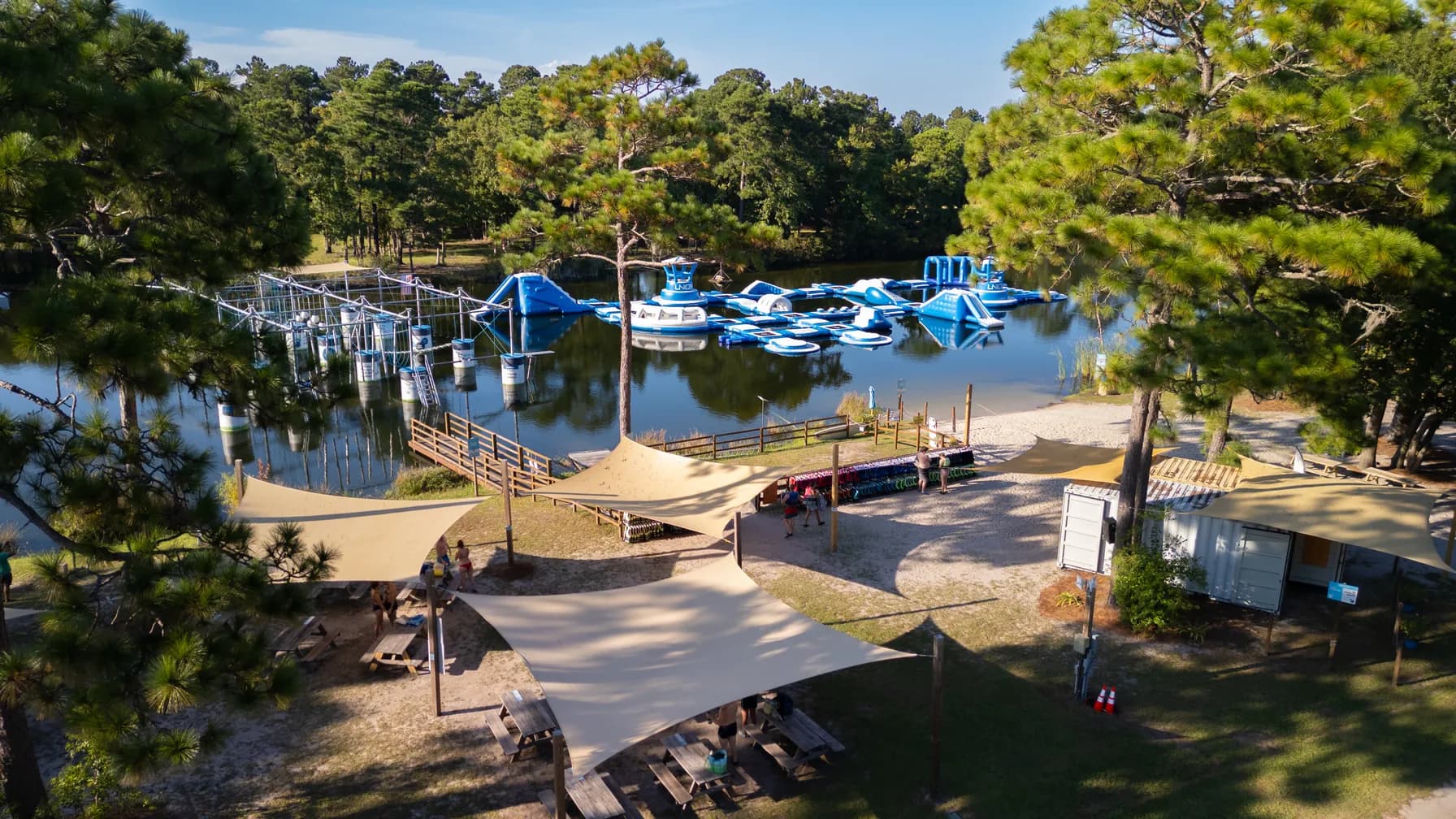
That is the whole difference between a bundle and an upsell, and it is exactly why we do not bundle at Charleston Aqua Park, the FEC we run on wakesys.
Why are discounts and bundles the wrong move for an FEC?
A flat discount on your core product is the worst thing you can do. It lowers your anchor, it eats straight into your margin, and it trains guests to wait for the next deal. Bundles are better, because they sell value instead of price. Yet at heart a bundle is still the sign offering chocolate with pistachio. It forces the guest to decide on everything up front, at the exact moment their willingness to buy is lowest. In the end they either abandon the purchase or pay for something they never use. Neither move grows per cap. One shrinks it and the other leaves the decision in the wrong place.
What does an in the moment upsell look like?
An in the moment upsell is a single, small, optional add offered while the guest is already booking, priced below a separate purchase so that saying yes is easy. We ask for the scoop of vanilla instead of the combo. The guest books the Aqua Park, which is what they came for, and adds the Ropes Course as an upgrade while booking, or the other way around. One click, and the second activity is included at a preferred price.
The activities are ours, but the mechanic is any FEC's. Trampoline court plus laser tag. Bowling plus the arcade. Climbing plus a birthday party room. Whatever your second thing is, you offer it at the moment the guest has already committed to the first, not as a package they have to weigh before they have decided anything.
How much does upselling actually add per booking?
Every figure that follows is real data from Charleston Aqua Park, not a model. This year handed us the perfect experiment, because we switched from the old wakesys to the new one in the middle of the season. Booking the upgrade online only went live partway through, around the middle of June. Within three weeks the share of bookings that included an upgrade climbed from zero to more than 30 percent, reaching from a standing start the attach rate our old system had held for over four years.
When we first wrote this up we had barely two weeks of data and we said the trend was still pointing up. It was not, and that turned out to be the better news. Here is every week since the upgrade went live:
| Week starting | Eligible online bookings | Added the second activity | |
|---|---|---|---|
| 15 June | 223 | 22.0% | partial, the upgrade went live mid-week |
| 22 June | 312 | 32.1% | |
| 29 June | 397 | 33.8% | |
| 6 July | 312 | 30.1% | |
| 13 July | 256 | 31.6% | |
| 20 July | 269 | 33.5% | |
| 27 July | 314 | 28.7% | |
| 3 August | 233 | 29.2% | |
| 10 August | 212 | 40.6% | |
| 17 August | 183 | 30.6% | |
| 24 August | 57 | 21.1% | schools back, weekends only |
| 31 August | 132 | 25.8% | |
| 7 September | 84 | 25.0% |
The three rising readings we called a trend in July were really a partial launch week, one full week, and a week that had run for two days. Twelve full weeks have closed since then, and the shape is a plateau with one spike, not a climb.
It did not keep climbing. Through the peak it stayed between 28.7 and 33.8 percent, with a single 40.6 percent week in mid August, and once schools went back and the crowd changed it settled in the mid twenties. Across the whole season, 31.1 percent of online bookings added the second activity, the same figure we reported in August. A number that holds that steady across 2,946 bookings is not a launch novelty or a curiosity of one good fortnight. It is what the offer is worth when you put it in front of people at the right moment, and you can plan a season around it.
And yes, the guest does not pay full price for the second activity. That is precisely the point. The upgrade is deliberately cheaper than a separate booking, but the price is not a guess. Over the years we tested different upgrade prices to find the best balance between extra revenue per upgrade and the number of guests who upgrade at all. Set the price too high and too few take it. Set it too low and you leave money on the table. The concept behind this is price elasticity. If the term is new to you, read the Wikipedia article on it or ask ChatGPT or Claude to explain it.
Here is what the cart looks like:
| Cart | Without upgrade | With upgrade |
|---|---|---|
| Group base booking | $55.04 | $63.87 |
| Discounted second session, same activity | $5.79 | $1.19 |
| Surcharge for the second activity | $0.00 | +$40.12 |
| Extras at booking | $2.91 | $7.10 |
| Cart total | $63.74 | $112.27 (+76%) |
A booking here is usually a whole group, which is why the base line holds more than a single ticket price. The base sits slightly higher on upgrade bookings simply because those groups tend to be a touch larger on average, not because of any manipulation. The real lift comes from two places. First, the upgrade to the second activity, which brings in $40.12 per booking on average, because as a rule the whole group upgrades together. Second, these guests buy roughly twice as many extras. We break out the discounted repeat sessions of the same activity on purpose, so it stays clear what is genuine second activity revenue and what is simply a repeat of the same one. That is the scoop of vanilla, on every single order.
The decisive number. Spread the second activity across all online bookings, including the two thirds that come without an upgrade, and it works out to $12.30 more per booking on average. Automatically, and on every one. Over the season since launch that is $36,224 in extra revenue, and $49,126 once you count the discounted repeat sessions of the same activity alongside it. That is online only, only the Aqua Park and Ropes Course combination, and before any of the extras we sell on site.
The rate held flat, so where did the extra $2.61 come from?
This is the part we did not see coming, and it is the most useful thing in the whole data set. Compare the months:
| Month | Attach rate | Revenue per upgrading booking | People per upgrade | Revenue per booking, all in |
|---|---|---|---|---|
| June, from the 17th | 31.1% | $34.43 | 3.11 | $10.55 |
| July | 31.9% | $39.73 | 3.56 | $12.62 |
| August | 31.3% | $42.05 | 3.65 | $12.86 |
| September, to the 17th | 24.8% | $54.10 | 4.56 | $13.16 |
The share of guests saying yes barely moved through the peak, and even in September, when it slipped to a quarter, the revenue per booking still went up. What moved is who was saying yes. As the season went on the groups got bigger, and because the whole group upgrades together, every yes got worth more. The upgrade went from 3.11 people in June to 4.56 in September, and the revenue behind each one went from $34.43 to $54.10.
You can see the same thing in the attach rate by party size. A guest booking alone adds the second activity 22.6 percent of the time. A party of four does it 33.5 percent of the time, and a party of seven does it 50.9 percent of the time. Nobody in a group of seven wants to be the one who books the smaller day out. The upsell is not really being sold to an individual, it is being sold to a group decision, and groups say yes more readily than the people in them would alone.
The practical version of that: if your season has a peak, the upsell earns disproportionately during it. It does not simply scale with attendance, it scales with attendance and with party size at the same time.
But won't the discount cost me full-price sales?
This is the first objection every operator raises, and it is the right one to raise. If you sell the second activity at $9.99 on a weekday or $11.99 at the weekend instead of the $16 to $18 it costs on its own, are you not just handing a discount to people who would have paid full price?
Two things in the data answer it, and the first one is not the answer we expected.
We can measure the cannibalization directly, because we ran half of this season without the upgrade flow. Same park, same prices, same guests, just no upgrade offered at booking. Here is the before and after, both on online bookings that included an Aqua Park or Ropes Course admission, measured the same way on each side:
| Before the upgrade, 1 May to 16 June | After, 17 June to 17 September | |
|---|---|---|
| Bought both activities | 5.4% | 31.1% |
| Bought both at full price | 5.4% (37 bookings) | 0.3% (9 bookings) |
| Second activity revenue per booking | $2.69 | $12.52 |
So the cannibalization is real, and you can see it in the middle row. The guests who used to buy the second activity at full price essentially all moved to the discounted one. Thirty seven became nine, out of nearly three thousand bookings. If that is the only row you look at, the upgrade looks like a giveaway to people who were already paying.
Now look at the row above it. The share of bookings taking a second activity went from 5.4 percent to 31.1 percent, and the revenue the second activity earns across all bookings went up more than four and a half times. You give up the full price on roughly one booking in twenty, and you gain a discounted second activity on roughly one in three. That trade is not close, and it is the honest version of the answer. The question is not whether you lose full price sales. You do. The question is what you get for them.
The second objection is subtler, and worth checking properly. Maybe the guest who does both activities in one day has had their fill and does not come back, while the guest who only did the Aqua Park returns and pays again. That would be real cannibalization, and it would not show up in a single day's numbers.
So we tested it. We took every guest whose first online booking fell in the window and who had at least 28 days of follow-up left, 2,319 people in all, split them by whether they upgraded, and counted who booked again within those 28 days. The two groups came back at the same rate; the small gap between them is not statistically significant at 95 percent confidence. What is not close is the money. An upgrading guest was worth $123 across the month against $71 for a guest who did not upgrade. Some of that gap is simply that larger groups upgrade more often, so do not read the whole $52 as caused by the upsell. But none of it came back out of a lost return visit, and that is the thing the objection was actually about.
What does this do to your quiet attraction?
Here is the number that changed how we think about our own park. Over the whole season since launch, counting every ticket sold through every channel:
| Activity | Sold as the main booking | Sold as an upgrade | Share coming from the upsell |
|---|---|---|---|
| Aqua Park | 15,889 | 2,308 | 12.7% |
| Ropes Course | 963 | 4,596 | 82.7% |
Read the second row again. Five out of every six Ropes Course admissions we sell exist only because somebody was already booking the Aqua Park and got asked. As a product people seek out and book on its own, the Ropes Course sells 963 tickets in a season. As the scoop of vanilla, it sells 4,596.
Almost every FEC has a Ropes Course. It is the attraction that made sense on the plan, that cost real money to build, and that nobody drives across town for. The lesson is not that the attraction is weak. It is that the attraction has no demand of its own and enormous demand as an addition, and the only thing standing between those two facts is whether your booking flow asks.
The timing works in your favor too. Our main product sells the morning: 38.6 percent of base sessions start at 10 or 11am. Upgrade sessions do the opposite and land in the middle of the day, where the noon slot takes 20.5 percent of upgrades against 9.5 percent of base bookings, and the 2pm slot takes 17.6 percent against 11.4 percent. The upsell is not competing for the slots that were already going to sell out. It is filling the trough after the morning rush, on capacity you have already paid for. In business terms this is yield management, and it is the reason the upsell is worth more than its margin suggests. A slot you were going to run half empty anyway has no real cost to fill.
We tested the bundle side by side, and it did nothing
Everything above argues that the bundle is the wrong shape. It is fair to ask whether we ever tried it. We did, in the same season, on the same guests. At the end of July we added an "Aqua Park & Ropes Course Combo" card to the booking page, right next to the Aqua Park card. The straight-out bundle, offered up front, before the guest has decided anything.
People clicked it. In the seven weeks it has been live the combo card drew 6,515 clicks, a 32 percent click rate on its impressions, and nearly as many clicks as the Aqua Park card itself at 7,148. If clicks were sales, the bundle would have been a hit.
It changed nothing. In the four full weeks before the card appeared, 32.3 percent of eligible bookings added the second activity. In the four full weeks after, 31.9 percent. Of the guests who entered through the combo card, fewer than half actually ended up with a Ropes Course ticket: 1,784 Aqua Park admissions were bought through that card against 828 Ropes Course admissions. They clicked the combo, and then they decided at the same point everyone else does, when the question is asked mid-booking. The card took clicks away from the Aqua Park card and handed them to the same upgrade screen. Same guests, same decision, same moment, same answer.
That is the bundle in one experiment. It can win the click, because "combo" sounds like a deal. It cannot move the decision, because the decision was never made on the grid. It is made after the guest has committed to the thing they came for.
Why do guests like it?
Guests like it when everything comes from one place, because it removes friction. One less decision at every station, no more wondering whether the extra is worth it, and a day they can plan with the good feeling of having made the most of it. Less friction means higher conversion and happier guests at the same time.
It also compounds. Guests who added the second activity bought extras on 32.9 percent of bookings against 21.3 percent for everyone else, and they bought 1.34 items per booking against 0.65. Same shop, same prices, twice the attachment. A guest who has committed to a full day buys the water shoes and the shaved ice. A guest who booked ninety minutes does not. Across the season, second activity upgrades were 11.0 percent of everything we took online and extras another 3.8 percent, so about one dollar in seven of what we take online now comes from something the guest was asked about rather than something they came for.
One more thing worth knowing before you assume this only works on a busy Saturday. The attach rate barely moves by day of week: 37.5 percent on Wednesdays, 31.1 percent on Saturdays, 25.8 percent on Fridays, and a 30.6 versus 31.5 percent split between weekdays and weekends overall. A single ticket turns into a whole day on a wet Tuesday just as reliably as it does in peak weekend traffic, and per cap goes up without you touching your headline price.
If your booking system cannot do this, it is not costing you what you pay for the license. It is costing you everything you are not making on top.
A system that leaves a good $12 per booking on the table is no bargain, however cheap the license looks. One season, one activity pairing, online only, came to $36,224. That is no longer a software cost conversation. It is five figures of revenue you never earned, year after year.
Nobody comes for the combo deal. But almost everyone takes the scoop of vanilla, if you ask at the right moment.
This is exactly how we built booking in wakesys, because we run on it ourselves at Charleston Aqua Park every day. It is all here in one place: group rates, second-session discounts, upgrades and add-ons. If you want to see the in the moment upgrade at work, book a demo and we will walk you through it.
FEC upselling FAQ
What is the difference between bundling and upselling at an FEC?
A bundle asks the guest to decide on everything up front, at the moment their willingness to buy is lowest, so many either walk away or pay for something they never use. An upsell offers one small addition at the right moment, once the guest has already committed to what they came for. Same total in the end, but far more people say yes to the upsell, which is why it grows per cap while a bundle usually does not.
How can I increase per cap without raising my prices?
Add a second decision instead of a bigger one. Keep your headline ticket where it is, and offer a discounted second activity and a few add-ons at the point of booking. Because the guest opts into each one, the basket grows on its own. Across 2,946 of our online bookings, including the two thirds that add nothing, the second activity alone works out to $12.30 more per booking, with no change to the base price.
Should I discount the second activity?
Yes, on purpose. The upgrade is deliberately cheaper than a separate booking, but the price is not a guess. Set it too high and too few take it. Set it too low and you leave money on the table. Over the years we tested different upgrade prices to find the balance between extra revenue per upgrade and the number of guests who upgrade at all. The concept behind this is price elasticity.
Does discounting the second activity cannibalize full-price sales?
Yes, and it is still worth it by a wide margin. We ran half a season without the upgrade flow, so we can compare directly. Before it, 5.4 percent of online bookings bought both activities and all of them paid full price. After it, 5.4 percent became 31.1 percent, while full price purchases of the second activity fell from 37 bookings to 9. You lose the full price on about one booking in twenty and gain a discounted second activity on about one in three, which took second activity revenue per booking from $2.69 to $12.52. Separately, in a matched test of 2,319 first-time guests with 28 days of follow-up, upgraders and non-upgraders returned at the same rate, with no statistically significant gap, so the discount did not eat a return visit either.
What attach rate should I expect for a second activity?
It depends on your activities, your prices, and where the offer sits in the flow, so treat any single number with care. For context, at our park the rate sat between 28.7 and 33.8 percent through every complete peak week, spiked to 40.6 percent once, and eased to the mid twenties after schools went back, averaging 31.1 percent across 2,946 online bookings for the season. It holds within a few points on weekdays and weekends alike. The point is less the exact figure and more that a well timed, well priced upsell moves it and then keeps it there.
Does the attach rate keep climbing after launch, or does it plateau?
Ours plateaued within about three weeks and has held flat since. What kept growing was the value of each upgrade, because party sizes rose through the season and groups upgrade together: revenue per upgrading booking went from $34.43 in June to $54.10 in September while the attach rate stayed near 31 percent through the peak. Plan for a rate that levels off quickly and for a per-booking figure that tracks your peak season.
Would a combo or package option on the booking page help as well?
We tested exactly that. A combo card on the booking grid drew 6,515 clicks in seven weeks, nearly as many as the main Aqua Park card, and the attach rate did not move: 32.3 percent in the four weeks before it, 31.9 percent in the four weeks after. Fewer than half of the guests who clicked the combo ended up with the second activity, because they still decided at the upgrade step like everyone else. Offer the second activity at that step and skip the package.
Where in the booking flow should the upsell appear?
At the moment the guest has committed to their first activity, not before. In our flow the group picks its activity and time, then sees add-ons, then a second activity offered at an upgrade price, and only when that activity still has room that day. Asking earlier turns the upsell back into a bundle, and asking about something that is already full just frustrates people.
Which of my attractions should I put behind the upsell?
The one nobody books on its own. At our park 82.7 percent of all Ropes Course admissions are sold as an upgrade rather than as a main booking, against 12.7 percent for the Aqua Park. The attraction with weak standalone demand and spare mid-day capacity is exactly the one that gains most, because you are filling slots you have already paid for rather than competing with your own peak.
Updated 17 September 2026 with the full season. The original version of this article, published 2 July 2026, was based on the first two weeks after launch: 663 online bookings, a 31.1 percent attach rate and $10.71 per booking. The 7 August update recalculated everything on 2,175 bookings and found the same 31.1 percent and $12.04 per booking. This version recalculates every figure on the whole season from 17 June to 17 September 2026, which is 2,946 online bookings: the attach rate is still 31.1 percent, revenue per booking is $12.30, and the September numbers show the rate easing once schools go back while the value of each upgrade keeps rising with party size. The section on the combo card test is new.
The ice cream figures come from the IDFA National Ice Cream Trends Survey 2026 and YouGov. The revenue numbers are our own aggregated and anonymized Charleston Aqua Park data for online bookings from 17 June to 17 September 2026, net of refunds. The combo card figures come from our GA4 property over the same period. No personal data is used, only aggregates.

Chris Hilbert
Founder, wakesys
Park operator and software founder. Running Charleston Aqua Park and building wakesys to help activity centers succeed.