A Signed Waiver and a Valid Waiver Are Not the Same Thing
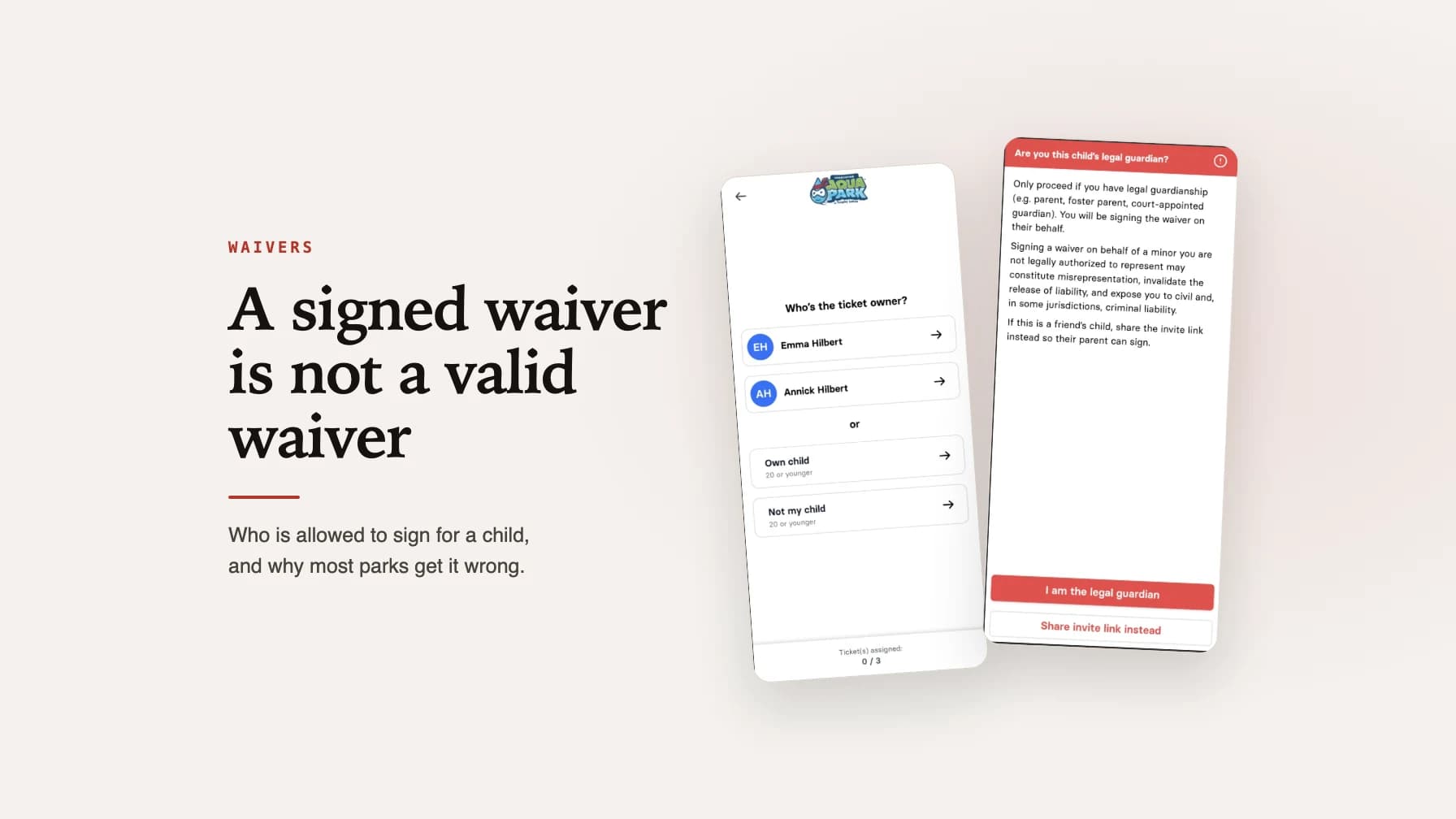
This is not legal advice, and we are not qualified to give any. We build booking software and we run a family entertainment center on it. Everything below is what we have learned the slow way, from operating a park, from our insurance broker, and from lawyers correcting us after the fact. Waiver law varies enormously between countries and between US states, and something that holds in South Carolina can be flatly untrue two states over. Treat this as a list of questions worth putting to your own attorney, not as answers.
Here is the thing that took us longest to learn, and the one we would most want another operator to hear. For years we believed that a signed waiver was a signed waiver. Collect them all, file them, and you have done your job.
You have probably not done your job. And the way you find out is the worst possible way: eighteen months after an incident, when a lawyer opens your file for the first time and tells you what you are actually holding.
Who can legally sign a waiver for a child?
In most jurisdictions, a release covering a minor only carries weight when it is signed by that child's parent or court-appointed legal guardian. Not the birthday mum. Not the aunt. Not the neighbour who did the school run. Not the team coach. If the person who signed had no legal authority over that child, the document you are holding may do nothing at all.
Now count how often that happens at your park. A birthday party with eight children and one adult present. A sleepover group. A church trip. A dad who brings his son and his son's two best friends. In a family entertainment center this is not an edge case, it is a Saturday.
You have a waiver in hand, and it is worth roughly the same as having no waiver at all. You simply do not know it yet.
The uncomfortable version of this is that it can be worse than nothing, because it produces false confidence. You stop asking whether you are covered. You have a file full of signatures and a feeling of diligence, and neither survives first contact with an injury lawyer.
The harder version nobody warns you about
There is a second layer to this that we did not know either. Even when the actual parent signs, a number of US states will not enforce a pre-injury release against a child's own claim, on the grounds that a parent cannot bargain away a right that belongs to the child. Other states will enforce it. Some enforce it only within statutory limits. This genuinely differs by state, which is the single strongest argument for having a local attorney read your waiver rather than trusting anything you read online, including this article.
The practical takeaway is not that waivers are pointless. It is that the waiver is one layer of a defense, not the whole of it, and a waiver signed by the wrong person is that layer collapsing before anyone has even tested it.
We did not know. So how would she know?
This is the realisation that reframed the entire problem for us, and it is the reason our software works the way it does now.
We ran a park without knowing this rule. We are the operator. We had every commercial and personal incentive to know it, and we did not. So what chance does a mum have, standing in a lobby with six over-excited children and a phone in one hand, of knowing that agreeing on behalf of her son's friend is worthless and potentially exposes her personally?
She is not being careless. Nobody has ever told her. And the industry's standard answer, a checkbox reading "I confirm I am the parent or legal guardian", does not tell her either. That checkbox exists to protect the operator, not to inform the guest, and everybody taps it without reading it. It is a liability decoration.
If the operator did not know, the guest has no chance. Leading people to the right answer is the booking system's job.
So we stopped trying to validate the relationship and started trying to steer it. Internally we call these traps, though that is the wrong word for what they do. They are not there to catch anyone out. They are there to make the correct path the obvious one, and to make the incorrect path require a deliberate decision that the guest can no longer claim they did not understand.
It works in three steps.
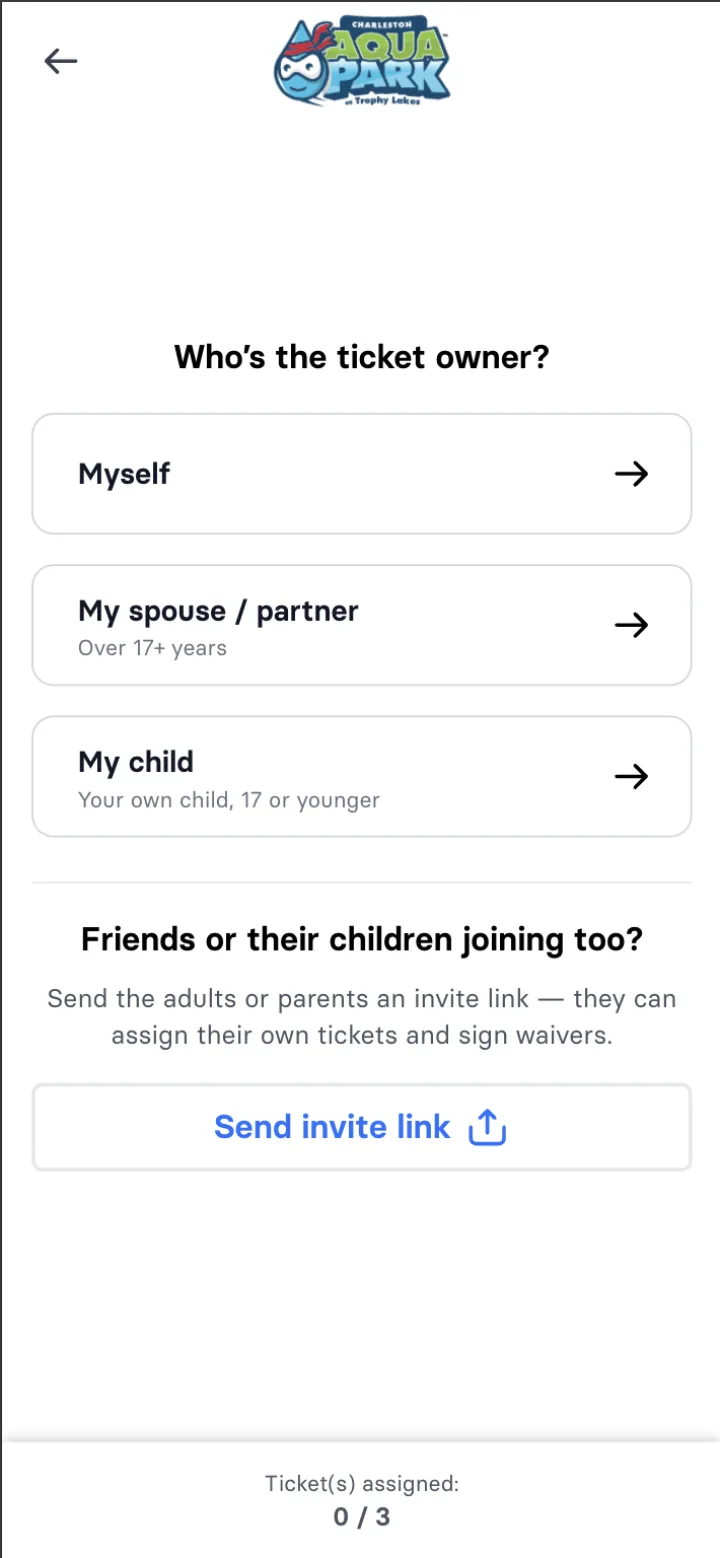
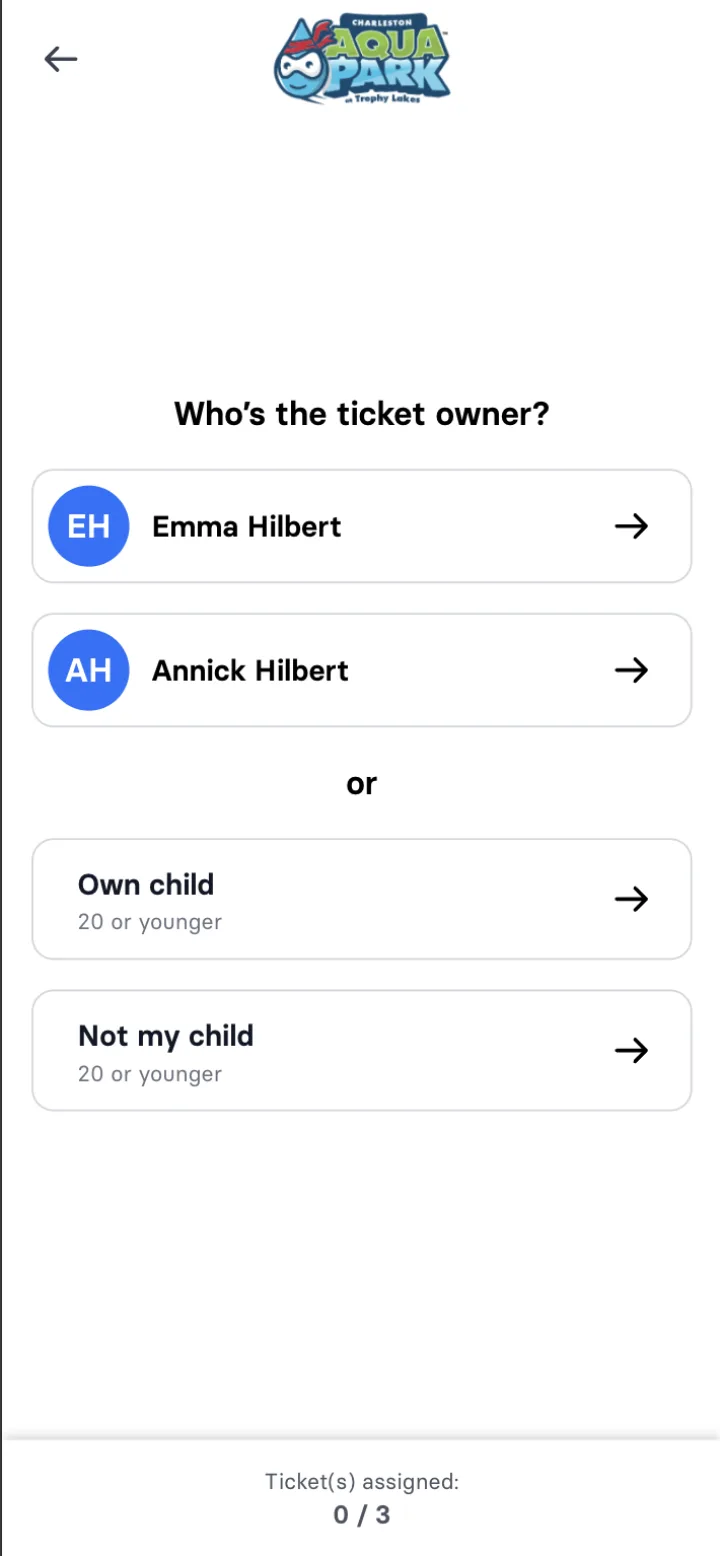
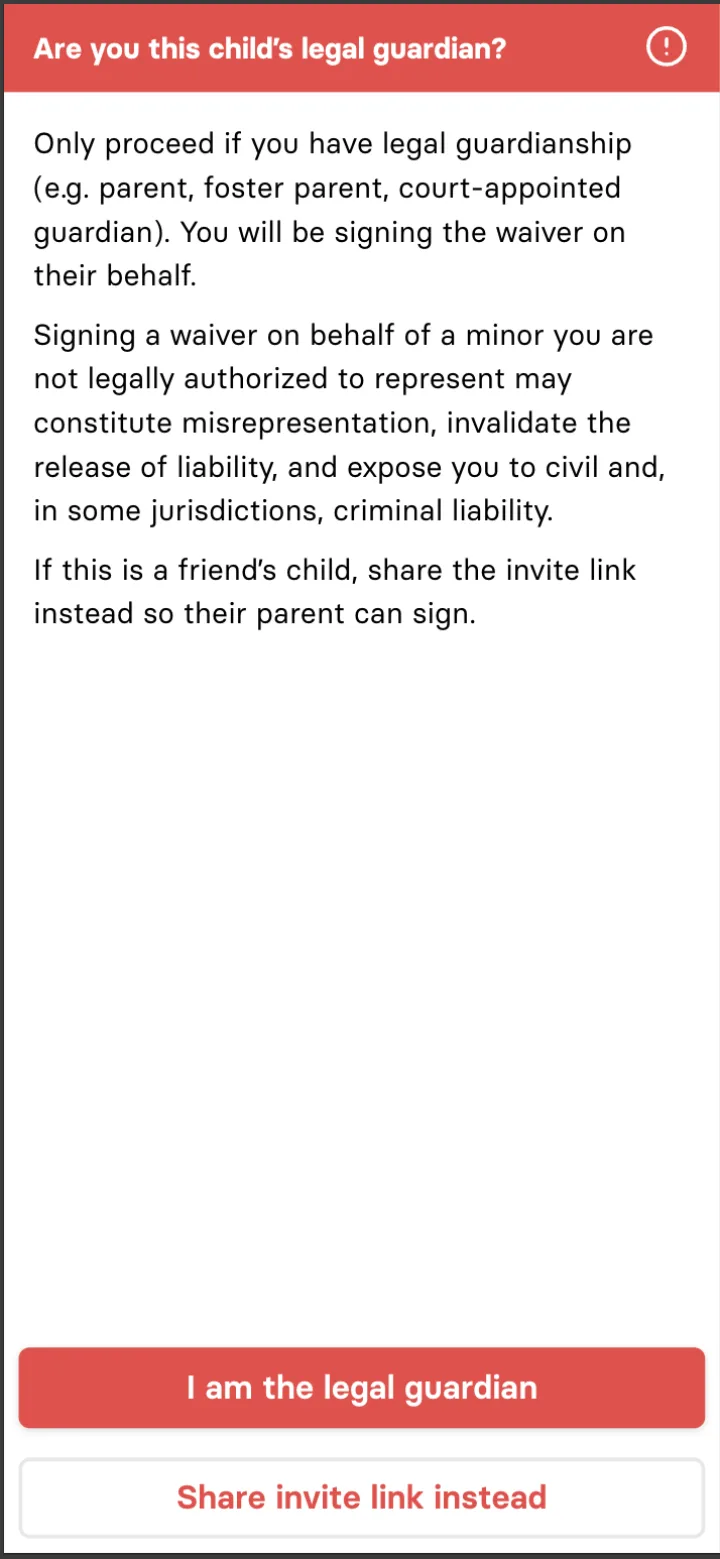
The same offer appears at every step, not only at the end. Most people take it, because sending a link to the other parent is genuinely easier than lying to a full-screen warning.
The design principle underneath all of this is that friction belongs in exactly one place: immediately before a mistake. Everywhere else the flow should be fast. A guest assigning tickets to their own family never sees the warning at all.
And when the wrong person does sign anyway, the relationship is stored as a real field rather than a checkbox, so the system can act on it later. If that child comes back with their actual parent, we recognise the child, see that the existing waiver was signed by a non-guardian, and ask the parent to sign one that supersedes it. The valid waiver ends up on file, which is where you needed it all along.
Why group waivers are a bad idea, twice over
One adult, one signature, a list of eight names. Every operator has been tempted by this, because it is so much faster on a busy Saturday.
The first problem is everything above, multiplied by eight. If seven of those children are not hers, seven of those releases are likely worthless.
The second problem is subtler and, we are told, easier to argue. Look honestly at what a group waiver in most booking systems actually looks like on screen: a form, a heading, and a list of name fields. It reads like a registration sheet. A lawyer only has to persuade a jury that the mum believed she was listing the children who were attending, not individually surrendering each child's legal rights. That is not a difficult argument to make, because in many cases it is a fair description of what she believed.
One signature covering eight people creates ambiguity about consent. One signature per person, from the person entitled to give it, does not. The slower path is the one that survives.
Look at the signature
This one sounds trivial and is not.
People sign with a dot. A smiley face. A single flat line. The letter X. A scribble that took a quarter of a second. On a phone screen, with a finger, while holding a toddler, a meaningful number of guests do not produce anything resembling a signature, and no system stops them.
You will not notice. The record says signed, the status turns green, the guest walks in. You discover it on the day it matters, which is the day it is far too late to fix.
So we put the actual signature on the check-in screen, next to every name, at the moment staff are looking at the booking anyway.
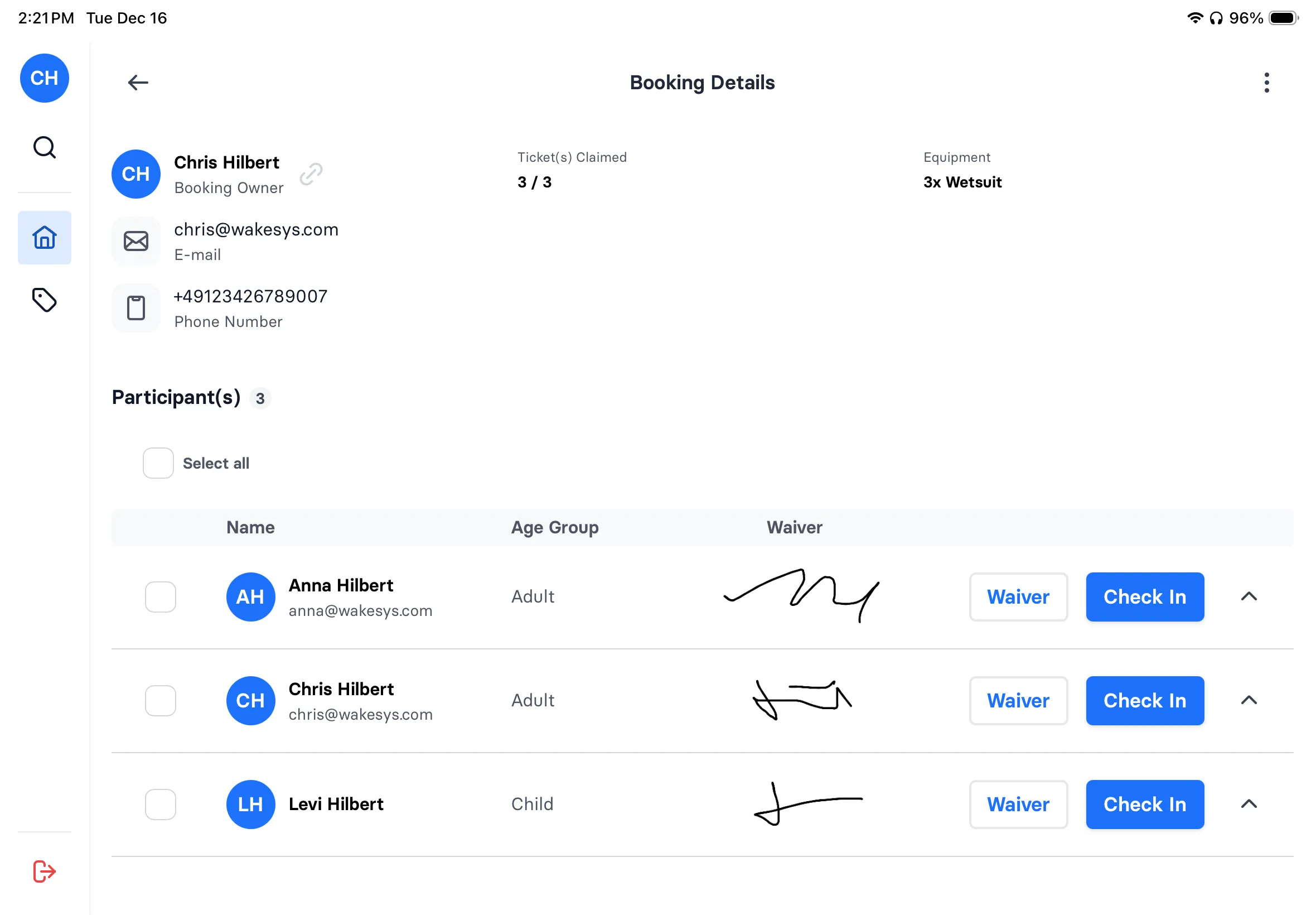
It costs nothing to display and it changes behaviour on both sides of the counter. Staff spot the ones that are not real. Guests who know their signature will be looked at tend to draw one.
What is a liability waiver actually for?
A lot of operators, including us for a long time, carry the idea that a waiver is a shield. Sign here and you cannot sue us. That is not what it is.
A waiver's main job is to communicate inherent risk and record that the guest understood it. Inflatable water parks involve falling into water from a height. Ropes courses involve being off the ground. Trampolines involve landing badly. These risks cannot be engineered away without removing the activity, and a waiver is where you set that out plainly and the guest acknowledges it.
What a waiver generally does not do is protect you from your own negligence, and it very reliably does not protect you from gross negligence or reckless conduct. If the anchor line was known to be frayed, if the attendant was untrained, if the supervision ratio was wrong, if a hazard was reported and ignored, no signature saves you. Courts across jurisdictions are consistent on this point even when they disagree on everything else.
A waiver covers the risk that is inherent in the activity. It does not cover the risk you introduced by running it badly.
Which means the waiver is the last layer, not the first. Inspections, training, staffing ratios, incident logs and maintenance records are what actually protect a park. The waiver documents that the guest knowingly accepted the risks that remained after you did all of that properly.
The very long tail of a minor's claim
One more thing our broker explained that we had never considered. In many jurisdictions the clock on a minor's claim does not start until they reach adulthood. A seven-year-old injured at your park this summer may be able to bring a claim well into the 2040s.
That has a mundane but serious operational consequence. You need to be able to produce that exact document, unchanged, a very long time from now, and show that it has not been altered since signing. A shoebox of damp paper cannot do that. Nor, honestly, can a database row that anyone with admin access could have quietly edited. It is worth asking any vendor how they would prove a waiver is unmodified, and what happens to your records if you stop being their customer.
Worth twenty minutes of your time
Our insurance broker put together a session on waivers and liability for park operators. It covers a lot of this from the insurance side, which is a different and genuinely useful angle.
Can you use AI to write a waiver?
This deserves saying plainly, because a lot of operators are already doing it quietly and worrying they should not be.
AI is genuinely good at producing the basis for a waiver, and better than a blank page or a template you found on a forum. The way to use it well is to make it interview you. Have it ask about every activity you run, the surfaces, the heights, the equipment, the age and weight limits, what has actually gone wrong before, how you supervise, and what your staff are trained on. Feed it waivers from comparable parks in your state so it picks up the language and structure that courts near you are used to seeing. You will end up with something far more specific to your operation than a generic download, and specificity is the thing that makes a waiver useful.
What you must not do is take that output and put it live.
An AI will produce something that reads authoritatively and is confidently wrong about your jurisdiction. It does not know which states void parental pre-injury releases. It does not know your state's rules on conspicuousness, on whether the word "negligence" has to appear explicitly, or what language courts near you have already struck down. It will not tell you it is unsure. An unenforceable waiver that looks professional is more dangerous than an obviously thin one, because you will stop worrying about it.
Use AI to get to a strong draft in an afternoon. Then pay a lawyer who actually works on injury and liability in your state to go through it. That review is not expensive relative to what it protects, and it is the only step in this entire article that we would call non-negotiable.
Where this leaves you
If you take only four things from this:
- Find out whether the waivers you already hold were signed by people entitled to sign them. For most parks the honest answer is that a meaningful share were not.
- Stop using one signature to cover a group of children.
- Look at your signatures. Actually look at them.
- Get your waiver in front of a local injury lawyer, whether AI drafted it or you inherited it from the previous owner.
Waiver FAQ for park operators
Can a non-parent sign a liability waiver for a child?
In most jurisdictions, no, at least not in a way that reliably protects the operator. A release covering a minor generally needs the signature of a parent or court-appointed legal guardian. A family friend, aunt, coach or birthday host usually has no legal authority to surrender that child's rights, so the release can be set aside, leaving the operator in the same position as if no waiver had been signed. Confirm the position in your own state with an attorney.
Are group waivers legally risky?
They carry two distinct risks. First, one adult signing for several children usually cannot cover the children who are not theirs. Second, a form that lists multiple names reads like an attendance sheet, which makes it straightforward for a lawyer to argue the signer believed they were recording who was present rather than individually waiving each child's rights. One waiver per participant, signed by the person entitled to sign it, avoids both.
Does a waiver protect against negligence?
A waiver's core function is to set out the inherent risks of an activity and record that the guest accepted them. It generally does not protect an operator against gross negligence or reckless conduct, and in many jurisdictions it will not cover ordinary negligence either. Untrained staff, skipped inspections, ignored hazards and wrong supervision ratios are not covered by any signature. Operational safety is the real protection, and the waiver documents informed acceptance of what remained.
How long do we need to keep a signed waiver for a minor?
Longer than most operators expect. In many jurisdictions the limitation period for a minor's claim does not begin until they turn eighteen, so a claim can arrive fifteen or more years after the visit. That means being able to produce the exact document years later and show it has not been altered since signing, which is why tamper-evident storage and full version history matter more for waivers than for almost any other record a park keeps.
Can I use AI to write my park's waiver?
Use it to build the draft, not to finish the job. AI is very effective when you let it interview you about your activities, hazards, age and weight limits and supervision, and when you give it waivers from comparable parks in your state as reference. What it cannot do is tell you whether the result is enforceable where you operate, because that turns on state-specific case law it will not flag and may get wrong with complete confidence. Always have an injury or liability attorney in your jurisdiction review it before it goes live.
How can a booking system reduce waiver risk?
By steering guests to the correct signer instead of asking them to self-certify with a checkbox. In practice that means asking explicitly whether a child is the signer's own, offering an invite link so the actual parent can sign from their own phone, warning clearly before someone signs for a child they are not authorised to represent, storing the signer-to-participant relationship as structured data rather than free text, showing the drawn signature at check-in so invalid marks are caught, and keeping tamper-evident records with version history.
Published 8 August 2026. Written by an operator, not a lawyer. Nothing here is legal advice, and waiver law differs by jurisdiction. Have your own waiver reviewed by an attorney who works on injury and liability in your state.

Chris Hilbert
Founder, wakesys
Park operator and software founder. Running Charleston Aqua Park and building wakesys to help activity centers succeed.